.png)
A Day Birding Folly Beach County Park in Charleston (eBird Hotspot #23)

Updated: Jul 31
As part of my goal to bird the top 50 eBird hotspots in Charleston, I recently spent a morning at Folly Beach County Park, ranked #23 with over 200 species recorded.

I set out on a cool, clear, sunny morning. It had been a while since I’d visited this spot, and I was excited for the day ahead.
A quick check of recent eBird reports showed that Red Knots had arrived along the Charleston coastline. These amazing sandpipers stop here each migration to refuel for their incredible journey.

The first bird of the day was a House Wren calling from the scrub along the parking lot. I moved closer to the chattering wren and found several other birds, including Song Sparrow, Swamp Sparrow, and Red-winged Blackbird.
Listen below to the House Wren call, with a Red-winged Blackbird and Song Sparrow in the background.
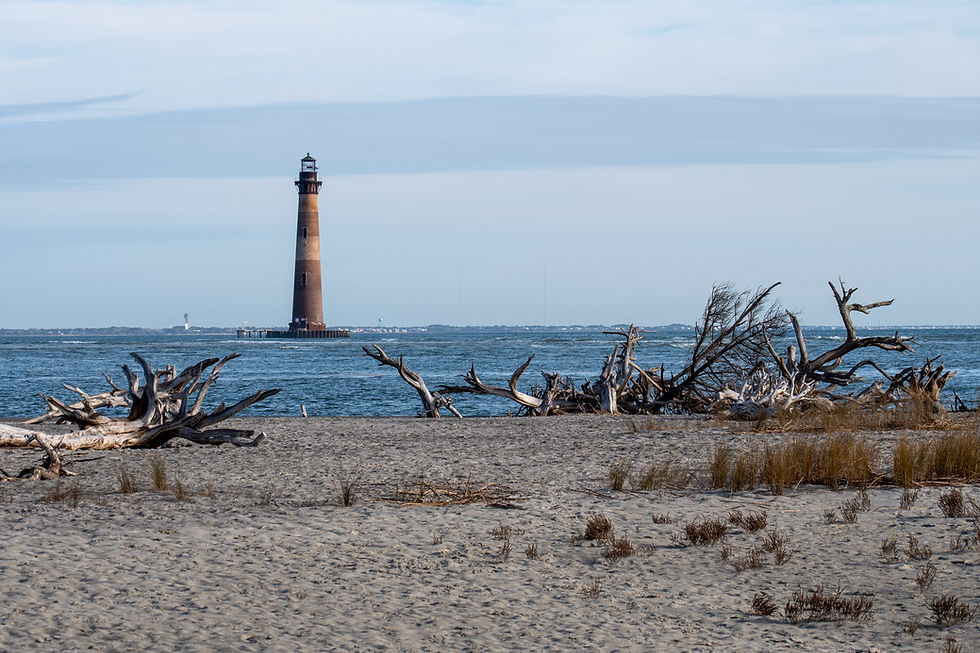
I walked along the sandy pathway through the dunes toward the beach. It was a beautiful sight, with clear blue skies over tranquil water. Gulls and terns patrolled the calm shoreline.
I noticed a rocky jetty still above the incoming tide, covered with Sanderlings and Ruddy Turnstones. It was an entertaining sight watching them forage in between the oncoming waves and rising water.


As I walked the beach toward the Folly River, I came across a Ring-billed Gull enjoying a fresh Cannonball Jellyfish. Scattered Sanderlings ran along the edge of the receding waves.


Further down the beach, I spotted three Black Scoters diving just offshore, disappearing beneath the surface before popping back up.


As I made my way down the beach, a large area of mud had been exposed by the receding tide. I watched a Black-bellied Plover searching for food in the mud, while a Willet probed a deeper pool nearby for its next meal.

Along the edge of the mud flat and oyster beds, there was a mixed flock of small sandpipers. Most were Dunlin, showing their longer, decurved bills. They were accompanied by several Least Sandpipers, our smallest sandpiper with yellowish legs, along with a few Western Sandpipers.
I walked a bit farther around the bend to explore more exposed mud flats and oyster beds. Along the way, I found several Boat-tailed Grackles, more Dunlin, and a Black-bellied Plover.


I returned to the mouth of the Folly River and set up my spotting scope to view birds resting on several distant sandbars. The sandbars were filled with Brown Pelicans, Forster’s Terns, Royal Terns, Laughing Gulls, Ring-billed Gulls, Herring Gulls, Dunlin, and Red Knots. I counted over 60 Red Knots foraging on a sandbar in the distance.

Red Knots are medium-sized sandpipers that stop in South Carolina during both spring and fall migration. Some travel over 9,000 miles each year, moving from their wintering grounds in South America to their breeding grounds in the Arctic. Unfortunately, Red Knot populations have declined by a staggering 87% since 2000. Charleston County hosts more than 40% of the population during migration.
To learn more about these remarkable birds, I’ve included a few helpful links at the end of this blog.

I counted the birds I could see through my spotting scope and tallied my eBird list. As I took in the long views across the water, a couple of Forster’s Terns began calling and patrolling the water nearby.
Out of nowhere, a Northern Harrier flew right over me and headed toward the salt marsh. I quickly snapped a few shots before the raptor disappeared out of sight.


I headed back down the shoreline, passing the same three scoters from earlier. I noticed a large bird sitting on the water in the distance and took a closer look through my scope. It turned out to be a Northern Gannet resting on the calm ocean. I also spotted a few larger groups of Black Scoters farther offshore.


It was a beautiful walk on a gorgeous March day in Charleston. I observed 37 species, highlighted by 62 Red Knots. I covered 1.54 miles in 1 hour and 31 minutes.
eBird checklist: https://ebird.org/checklist/S131865446
Happy Birding!
-Charles
Red Knot information:
Folly River Marsh Habitat Marsh and tidal creek Forster's Tern Forster's Tern Forster's Tern Folly River Brown Pelicans Brown Pelicans Mud Flat and Oyster Beds Spotting Scope for Sandbars Mostly Pelicans on Sandbar Red Knots on sandbar Red Knots on sandbar Gulls and Terns on sandbar Forster's Tern Dunes and Marsh Northern Harrier Northern Harrier Beach, Ocean Brown Pelican Maritime habitat Maritime habitat Folly Beach County Park, dunes Song Sparrow Northern Mockingbird